Archives of Liberation
A living archive — writings on the wall: extracts, reflections, and the words we draw on.
Archives of Liberation is a space for gathering the traces of what we create, witness, imagine, and remember together. As the collective grows, this page will hold the outputs of our practices: workshop images, participant reflections, written pieces, podcast clips, sound recordings, creative fragments, and other traces of collective work.
This archive is not a static record but a living space, where our practices of liberation will leave marks. A place where people can return to what was shared, made, spoken, written, moved, sung, walked, or remembered.
A place where the collective can see itself becoming.
The first traces

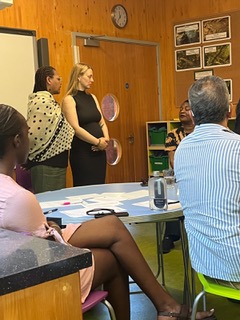

Writings on the wall
At each workshop, participants wrote their reflections onto the walls of the room — gathered under the three R’s of apology and repair: regret, responsibility, remedy. They are shared here as they were written, with names withheld.
Justice in Therapy
Black Psychotherapy UEL · 25 April 2026
Regret
“I regret that I did not have the voice to scream. I wish the group had not been silent. I regret that we stayed in the building — I feel that if we had gone out, things would have been different.
I regret the lack of creativity, the lost voice. I connect to the loss of the experience — something is lost and never be found. Wandering and wondering around the loss without never really accessing it.”
Regret
“What do you need from the institute that harmed you? What does it mean to you? Stop and reflect. Stop the harm. Shut up, don’t showcase, don’t tokenise, be honest with yourself.
Get help and support if you struggle. Look around you — are you showing people the door when you say that you are inviting them in? Are you moving people out of your way, to allow you to do the work to accommodate them? Take feedback on board. Stop. Deal with these contradictions — they are your problem. Don’t burden others with them.”
Regret
“I regret starting a psychotherapy course. I regret going in with an idealised view that I would be met with empathy, care and understanding. I regret the moment when I felt unable to speak when met with microaggressions. I regret speaking up and being met with violence. I regret that my institution doesn’t care for me the way they do to my white peers. I regret that they don’t give me the space to exist.”
Regret
“I would like psychotherapy institutions to hold themselves accountable for all the harm they have caused to marginalised communities. Trainees and students are subjected to harm and are expected to support clients, without realising the lasting impact it can have on the psychotherapeutic relationship. Psychotherapy institutions need to do better to ensure policies and practices are decolonial and courses are inclusive of students, trainees and staff from all backgrounds, particularly marginalised groups.”
Regret
“To regret is to acknowledge the harm that was done, who was harmed, what was harming, who did the harming. And only then to apologise — to express the regret, acknowledge the pain that was caused, whether intentional or semi-intentional, or somewhere in between.
The institution needs to remember that it’s made for its people and by its people. If the people were centred, then the regret — a real expression of regret — may be easier to access and express.”
Regret
“Learnt that regret is: sadness, guilt, shame. Wasn’t recognition, welcome of all feelings, taking responsibility, humility. Understanding need for and opportunities for care.”
Regret
“Restorative justice circles to process, acknowledge and name explicitly the harm. Collective witnessing, centering harm. Regret can be restorative — how? Institutions force splitting. Individuals internalising regret that institutions refuse to absorb. Whiteness defending itself at all costs.”
Regret
“I regret all the time that I held back my truth, the times I should have spoken out and didn’t out of fear. The time I’ve taken to learn to love myself. In not doing so, it’s held me back in speaking truth to power, not trusting I’m ok enough to have my words.”
Regret
“Not having said more.”
Responsibility
“Responsibility towards their own biases. I would prefer for it to come from a place of genuineness — to take accountability for their own discomfort, instead of placing it on the racially marginalised bodies.
To also take responsibility for dismantling their barriers, both in accessing the training, and also in ensuring the spaces and training are also safe spaces. If a collaboration is seen as vital, personal development is valued, then it needs to be embodied. Taking performative action and allyship is more harmful than outright ignorance — if decolonisation and anti-racism is truly how they want it to be embodied in all levels, in the teaching, the groups and the tutors themselves.”
Responsibility
“Responsibility requires acknowledgement of harm, listening and taking the time to understand, validate the person who expressed the harm caused. To be able to have a conversation without defensiveness, shutting down, silence. To accept responsibility and accountability openly, transparently and honestly.
Students of the global majority are given more responsibility in training — in placements, within dynamics with tutors, supervisors, the systems inside and outside the institution.”
Responsibility
“I would like them to take responsibility for the harm by actively taking the time to change the curriculum, in a way that can be improved to include white people AND those from the global majority. They need to do the work and the research on how to do that. I’m exhausted — even 4 years since qualifying, 6 years since the harm began.”
Responsibility
“People in positions of power often direct that power toward those who are more vulnerable or powerless. This can create imbalance, where control replaces support and inequality grows.
When this happens a rupture develops, trust is broken, relationships become strained and the environment no longer feels equal or safe. This disruption can hinder growth, fairness and the possibility of shared power and equality for everyone.”
Responsibility
“I would like my institution, before presenting lectures, to research Black and Brown perspectives in counselling and highlight writers and books — to recognise my lived experience isn’t. It is so exhausting to always call this out, and it becomes re-traumatic for me as a Black student.
I seek support from my family and other Black students on my course. I also joined groups run by BAATN and Black Psychotherapy, which run excellent workshops and trainings.”
Responsibility
“I wish you [‘progressive’ organisation] had really heard our concerns on harm when we first raised it. Instead you hid behind the perception of progression and we wasted so much time (and our energy) convincing you to just listen. Your whiteness stopped you listening. Your attachment to your perceived politics stopped you listening.
Now you might be listening, but we might have checked out. And all of this has happened before any action has been taken.”
Responsibility
“Power — do they have to double down on the reins? Release it. Learn from the response. Expect submission in the name of ‘robustness’. One complaint is one too many. It’s valid.
Me: be true. My responsibility is to be my authentic self, be honest, be who you truly are. Do not let their power silence you. You know what you feel, you know who has harmed, you know it’s wrong, and it is not your responsibility to hold their wrong — but speak in truth and let it loud. Be honest — don’t shrink — be true to self.”
Responsibility
“Whose is it? Where does it start? Societal — individual — authentic self — [harm] — silence — authentic self. ‘Your silence will not protect you’ (Audre Lorde). Silence — feelings: humiliation (thinking spaces to be safe).
Our responsibility to be ‘resilient’, ‘emotionally robust’ as therapists — this Eurocentric colonial view that we must be able to handle, for our clients, harm done to us by institutions, otherwise it reflects on us as not competent to be therapists. It’s not our responsibility, but we are always left holding it all. Responsibility on lecturers and tutors to hold each other accountable, due to power dynamics and students’ voices not being heard.”
Remedy
“To be heard and seen. Meaningful apology. Compensated. External monitoring. Acknowledging & reducing harm.”
Remedy
“To be heard / seen. Fit for purpose. Accountability. Support and advocacy. Glass ceiling.”
Remedy
“A refund — compensation — economic equity. Apologies, a true acknowledgement of harm. Renewal from the root. Holistic narrative for change. Visible and intentional accountability. Decolonising knowledge and practice distributions. Barriers to progression and performance. Hire us into permanent roles.”
Remedy
“Needs external accountability before going to legal procedures.”
Remedy
“I would not only like to be listened to for a day, a minute, or a moment — I would like to see evidence of the sophisticated frameworks promising inclusivity. I want to be afforded attention and time that you give to something that may affect you.
The invitation to take up space and be looked after by the tutors or facilitator. That is ensuring voices are heard, check-ins are carried out — but most importantly, not being rushed or treated as an inconvenience.”
Remedy
“Activism — taking action, being proactive — not just speaking but doing. Transparency — open and honest conversations. Accountability — really take accountability, reflection. Support — call out the oppressive behaviours, become an ally. Safeguard and protect my feelings, healing process. Be humble and open to being led.”
Remedy
“Don’t other me — attend to my lived experience and centre it in hearing my suggestions and complaints. Have compassion for the impact of my lived experience; focus on my psychological safety as I heal.
Consider what can be done to facilitate and anchor discussions which challenge students and lecturers to do the work now, alongside others, with power imbalances balanced as much as possible. Take an anti-oppressive approach — listen to me, climb inside my frame, validate the impact of systemic oppression in my lived experience, attend to my culturally informed perspectives with humility. Safeguard and protect me.”
Remedy
“Accountability and active listening. Empathy and compassion towards the harmed.”
When the Institution Harms II
Holland Park Ecology Centre · 13 July 2026
Regret
“Institutions must be honest in expressions of regret. Do not sugarcoat or displace responsibility. State what happened, then clearly outline what you will be doing to ensure you will not allow this to occur again!”
Regret
“An institution’s regret of their inaction. What they didn’t provide. What they knew — or guessed — might happen to me, but did nothing to safeguard me. What do we do to support marginalised students? We need to be invited to have our voice.”
Regret
“Genuine acknowledgement. Active change — consequence. Seeing the gap, the lack of care. Don’t put the responsibility on the individual. A display of care. Sense of self can be diminished, chipped away.”
Regret
“Active change: procedures and process. Visible actions — not just niceties and greetings. Formal processes that actively recognise the regret — that name and acknowledge, by and from the harmer. Individual accountability.
Structural change: trust is not just top down. Open dialogue. Process that takes care of the individuals and groups who have experienced harm. Acknowledging. Sealing the gaps.”
Regret
“Acknowledge politically their error — accountability of own shame. It’s not mine! Awareness of Eurocentric power. The proactive source base becomes the source of fear, insecurity, instability. Holding on to the fragmented self — not losing sense of self and power — and then to take responsibility to hold institutions accountable.”
Regret
“Demonstrating an action for change, not just words. Publicising where they went wrong, opening up discussions. Responsibility. Holding their shame.”
Regret
“Having things in place that make repetition impossible. Acknowledging how institutional power has made this harm permissible. Regret without action is futile. Justifying, theorising, or explaining the capacity for harm without taking accountability and working toward remedy is not enough. Passing shame back to the institution.”
Responsibility
“Don’t take any back and forth. No named identified person. Don’t follow own procedures. Hypocrisy. Respect the pattern of systemic oppression, controlling the narrative, smoke and mirrors. Inaction. Shut down, can’t speak, shame. Openly explore. Hidden, secretive.”
Responsibility
“Discomforting whiteness can be historically dangerous. Spectrum. Actions versus lip service. Moral injury — related to race, racial harm, cultural harm. Sacrifice my/your own power. Not doing the work individually.”
Responsibility
“Acknowledgement. Ownership and consequence — without being directed by the harmed party! CHANGE. Action, not just ‘feeling’. Real collaboration. Real platforms — giving a platform to Black and Brown people to do the work we want: funding, opportunity, power. Don’t ask us to thank you, congratulate you, or be GRATEFUL for your ability to see us as human!”
Responsibility
“‘What are the words you do not yet have?’ (Audre Lorde). Acceptance that injury has been caused. Willingness to engage — no defence. Tired of shouldering responsibility, or being responsible for making others take accountability. Don’t invalidate my lived experience, please. Don’t reject your own part in this, please. Place this front and centre of your course and your practice — never pressure, but be curious and ask. Don’t scapegoat or racially profile so a legitimate complaint is dismissed or minimised as ‘angry’.”
Responsibility
“Power — those with the greatest power hold the greatest responsibility; distribution of power. Diversity — meaningful representation of cohorts and teaching staff, of content, of a range of lived experiences throughout teaching, PD, guest lectures and speakers.
Care — the ethical framework should apply to training; unconscious bias of teaching staff must be examined; provide safe spaces for Black and Brown students and lecturers. Change — retention rates of Black and Brown students; advisory boards and advocates; awareness and accountability; empowering Black and Brown individuals beyond tokenistic, performative action; promote culturally sensitive organisation. Empathy and compassion breaks shame.”
Responsibility
“To be responsive with truth. Aggression — unconscious process. Acknowledge their inoculation. To be and stay uncomfortable. To avoid their avoidance. To recognise their own distress rather than enact it. To recognise their own ego ideals and not retaliate when they are challenged. To make a safe space where we can explore and allow our own aggression and anger.”
Remedy
“I continued the training to the end. I refused to be fobbed off with a diploma. Exhausted, broken — and fought for my earned grade. I would not accept less. Why? Because of those coming after me.
So: institutions MUST take responsibility. Those of the global minority who currently hold most power must educate their unconscious, and get rid of whatever generational trauma they are manifesting that makes them so needy and greedy. We of the global majority also have work to do — divest internalised untruths. Perpetrators give, and we make use of reparations to heal and take up our deserved spaces.”
Remedy
“Acknowledgement of the harm that has been reported. Acceptance that the harm has occurred. Work together to understand what happened, how it happened, and to do everything possible to ensure that it does not happen again. Practices and procedures must not be placed above the human condition — they should sit alongside it.”
The archive is just beginning — more traces will appear here as the collective grows.